
If you are a small business owner or LLC operator looking to reduce self-employment taxes, filing as an S Corporation (S Corp) may be one of the smartest tax strategies available.
But many entrepreneurs ask:
- What forms are required to file an S Corp?
- How do I elect S Corporation status?
- What documents do I need?
- How do I file S Corp taxes correctly?
- What is Form 2553 and Form 1120-S?
In this complete guide, KargIQ Tax & Business Solutions explains everything you need to know about filing an S Corporation properly — from election to annual tax filing.
If you’re searching for:
- How to file S Corp taxes
- S Corp election IRS form
- Form 2553 step by step
- Form 1120-S explained
- Small business tax preparation services
- S Corp tax filing near me
You’re in the right place.
What Is an S Corporation?
An S Corporation is not a business entity. It is a tax election that allows your LLC or corporation to be taxed under Subchapter S of the Internal Revenue Code.
Benefits include:
✔ Pass-through taxation
✔ Potential reduction of self-employment taxes
✔ Ability to split salary and distributions
✔ No corporate double taxation
✔ Credibility with lenders and investors
However, it also comes with additional compliance and filing responsibilities.
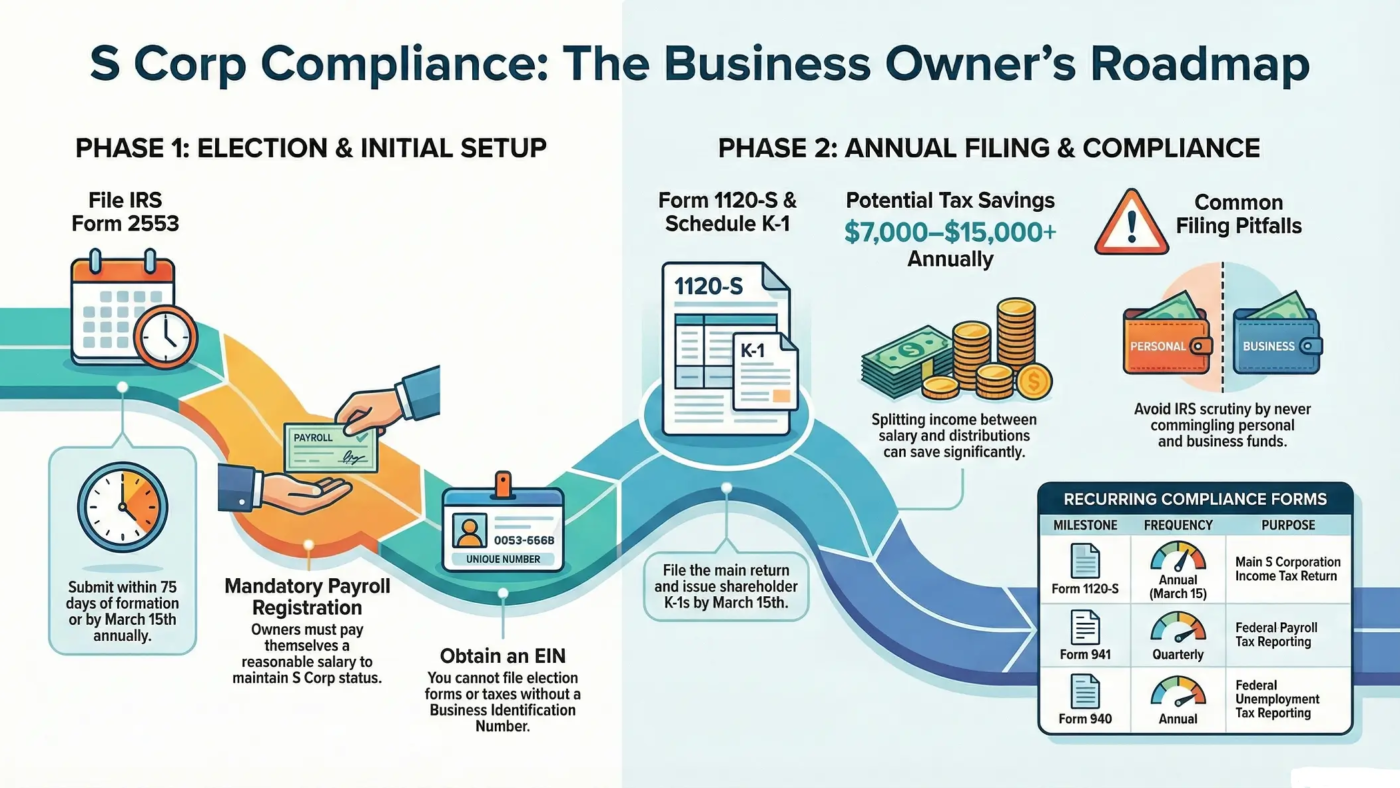
Step 1: Elect S Corporation Status (Form 2553)
Before you can file taxes as an S Corp, you must elect S Corp status with the IRS.
Required Form:
IRS Form 2553 – Election by a Small Business Corporation
Filing Deadline:
- Within 75 days of forming your business
OR - By March 15 of the year you want the election to take effect
Information Required on Form 2553:
- Legal business name
- DBA (if applicable)
- EIN (Employer Identification Number)
- Business address
- Date of formation
- State of formation
- Effective date of election
- Shareholder information
- Ownership percentages
- All shareholder signatures
⚠ Missing signatures are the #1 reason for IRS rejection.
Step 2: Obtain an EIN (If You Don’t Have One)
You cannot file Form 2553 or 1120-S without an EIN.
Required Form:
Form SS-4 (EIN Application)
This can be done online via IRS website.
Documents needed:
- Legal entity name
- Responsible party’s SSN
- Business address
- Type of entity
Step 3: Set Up Payroll (Mandatory for S Corps)
Once approved as an S Corp, owners must pay themselves a reasonable salary.
This requires:
✔ Payroll registration
✔ State employer accounts
✔ Federal payroll tax setup
✔ Workers’ compensation (if required)
Failure to run payroll can invalidate your S Corp tax strategy.
Step 4: Required Annual S Corp Tax Forms
Once your S Corp is active, you must file annually.
1️⃣ Form 1120-S (Main S Corp Tax Return)
IRS Form 1120-S
This is the official S Corporation income tax return.
Due Date:
- March 15 each year
Information needed:
- Profit and loss statement
- Balance sheet
- Payroll records
- Shareholder distributions
- Business expenses
- Asset purchases
- Loan activity
- Depreciation schedules
2️⃣ Schedule K-1 (For Each Shareholder)
Each shareholder receives:
Schedule K-1 (Form 1120-S)
This reports:
- Share of profit
- Share of losses
- Distributions
- Credits
The K-1 flows to the shareholder’s personal tax return (Form 1040).
3️⃣ Form 941 (Quarterly Payroll Tax Return)
If paying salary:
Form 941 (Quarterly)
Reports:
- Federal income tax withheld
- Social Security
- Medicare taxes
Filed every quarter.
4️⃣ Form 940 (Annual Federal Unemployment Tax)
Filed annually for unemployment tax.
5️⃣ State Payroll Forms (If Applicable)
Depending on your state (Florida, Texas, California, etc.), you may need:
- State unemployment tax reports
- State income tax withholding returns
6️⃣ W-2 & W-3 Forms
At year-end:
- Issue W-2 to yourself (as employee)
- File W-3 summary with SSA
Documents Required to File S Corp Taxes Properly
To avoid IRS audits or penalties, you must gather the following:
Business Financial Documents
✔ Profit & Loss Statement
✔ Balance Sheet
✔ Bank statements
✔ Credit card statements
✔ Payroll reports
✔ Owner distribution records
✔ Asset purchase receipts
✔ Loan statements
Corporate Documents
✔ Articles of Organization or Incorporation
✔ EIN confirmation letter
✔ Form 2553 approval letter (CP261 Notice)
✔ Operating agreement
✔ Shareholder agreements
Payroll Documentation
✔ Payroll summary
✔ Payroll tax deposits
✔ W-2 forms
✔ 941 filings
Additional Supporting Documents
✔ Mileage logs
✔ Home office documentation
✔ Equipment purchases
✔ Depreciation schedules
✔ Business insurance records
Organization is key.
Step-by-Step: How to File S Corp Taxes (Simplified)
Here is the cleanest workflow:
Step 1
Ensure Form 2553 is approved.
Step 2
Maintain clean bookkeeping throughout the year.
Step 3
Run payroll consistently.
Step 4
Close year-end books (reconcile accounts).
Step 5
Prepare Form 1120-S.
Step 6
Generate Schedule K-1 for each shareholder.
Step 7
File by March 15 deadline.
Step 8
Shareholders report K-1 income on Form 1040.
Common S Corp Filing Mistakes to Avoid
🚫 Not paying reasonable salary
🚫 Missing March 15 deadline
🚫 Failing to issue K-1
🚫 Commingling personal and business funds
🚫 No bookkeeping records
🚫 Incorrect distributions
🚫 Late payroll tax deposits
These mistakes can result in penalties or IRS scrutiny.
When S Corp May Not Be Right for You
You may not benefit if:
- Profit is under $30,000 annually
- You don’t want payroll complexity
- You plan to reinvest all earnings
- You operate part-time
S Corp works best for profitable, growing businesses.
Tax Savings Example
LLC Profit: $120,000
Without S Corp:
Full $120,000 subject to self-employment tax.
With S Corp:
Salary: $70,000 (subject to payroll tax)
Distribution: $50,000 (not subject to SE tax)
Potential tax savings: $7,000–$15,000+
Every situation is different — strategy matters.
How KargIQ Helps You File S Corp Properly
At KargIQ Tax & Business Solutions, we provide:
✔ Form 2553 filing
✔ Late S Corp election relief
✔ Full S Corp tax preparation
✔ Payroll setup & compliance
✔ Bookkeeping services
✔ 1120-S preparation
✔ Schedule K-1 preparation
✔ Year-round tax strategy
We serve:
- LLC owners
- Self-employed professionals
- Trucking companies
- Real estate investors
- Consultants
- E-commerce businesses
If you’re searching for:
- S Corp tax filing services
- File Form 2553 near me
- S Corp tax preparation in Florida
- Small business tax advisor
- Affordable S Corp accountant
KargIQ is ready to help.
Frequently Asked Questions
Can I file S Corp myself?
Yes, but mistakes are costly. Professional guidance is recommended.
Can I file S Corp late?
Yes, late election relief may apply.
Is bookkeeping required?
Absolutely. Clean books are essential for Form 1120-S.
Does S Corp eliminate all taxes?
No. It reduces self-employment tax, not income tax.
Final Thoughts
Filing as an S Corporation can significantly reduce taxes — but only if done correctly.
It requires:
- Proper election (Form 2553)
- Payroll compliance
- Accurate bookkeeping
- Timely Form 1120-S filing
- Proper Schedule K-1 reporting
If you want to reduce taxes legally and build a stronger business structure, S Corp may be the next smart move.
Ready to File Your S Corp?
Let KargIQ handle it the right way.
🌐 Visit: www.KargIQ.com
📞 Schedule a consultation today
KargIQ — Smart Tax Strategy for Individuals & Small Businesses.